
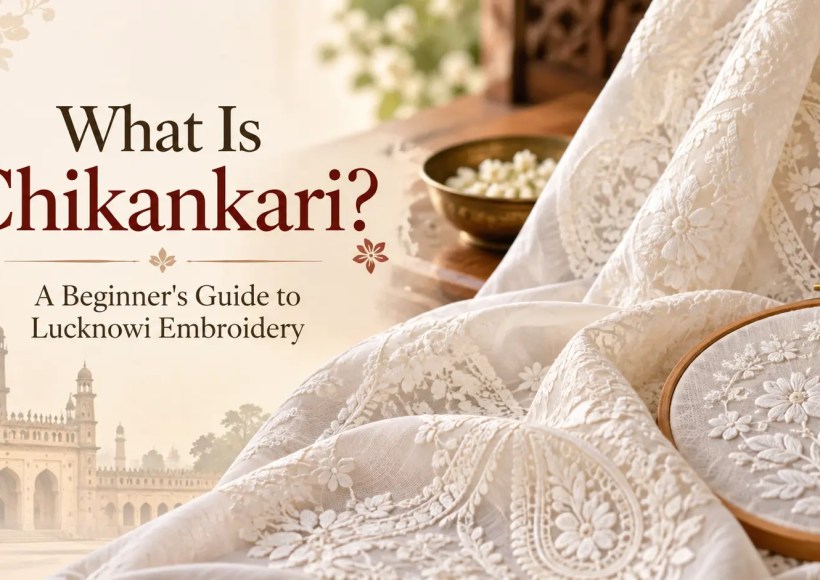
What Is Chikankari? A Beginner’s Guide to Lucknowi Embroidery
There is a reason a Chikankari kurti never really goes out of style. Look closely at one and you will see tiny, patient stitches that form delicate flowers, vines and leaves, each one worked by hand. That quiet detail is what makes Lucknowi embroidery one of India’s most loved textile traditions. If you have ever wondered what Chikankari actually is, how it is made, or how to tell the real thing from a lookalike, this guide covers it in plain language. What is Chikankari? Chikankari is a traditional hand embroidery from Lucknow in Uttar Pradesh, which is why it is often called Lucknowi work. It is widely believed to have flourished under Mughal-era patronage, and Lucknow Chikan craft today carries a Geographical Indication (GI) tag, which recognises it as a craft tied to its place of origin. Traditionally the embroidery was done in white thread on soft, airy fabrics such as mulmul and cotton, which made it ideal for hot weather. Today you will find it in pastels, earthy tones and bold colours, on everything from short kurtis to dupattas. How Chikankari is made The process is slower than most people expect: Design: A pattern is stamped onto the fabric using block prints made with washable dye. Embroidery: Artisans stitch over the pattern by hand, using different stitches for different parts of the motif. Washing and finishing: The fabric is washed to remove the stamped guide marks, then finished so the embroidery sits neatly on the cloth. Because so much of the work is manual, a single garment can take many hours to complete. Four Chikankari stitches worth knowing Chikankari uses dozens of stitches. These four will help you read almost any piece: Bakhiya (shadow work): Stitched from the reverse side of the fabric, so a soft, shadowy outline shows through on the front. It looks especially pretty on light, breathable cloth. Tepchi: A simple, long running stitch, often used to fill in motifs with a light, airy texture. Murri: Tiny, rice-grain-like stitches, commonly used for the centres of flowers. Jaali: A net-like openwork effect, created by gently separating the threads of the fabric instead of cutting them. You can see bakhiya work in our Chikankari 3/4-sleeve Bakhiya short kurtis. How to spot genuine hand-embroidered Chikankari Not every piece sold as “Chikankari” is hand embroidered. Here is a simple checklist before you buy: Turn it inside out. Hand embroidery looks neat but slightly varied on the reverse. Machine work tends to look perfectly uniform and flat. Look for small imperfections. Tiny differences in stitch size are a sign of a human hand, not a flaw. Check the fine details. Murri knots and jaali openwork are hard to fake convincingly. Feel the fabric. Good Chikankari sits on soft, breathable cloth such as cotton or mul, not stiff or scratchy material. Read the listing carefully. Look for clear wording such as “hand-embroidered” in the product name or description, and ask the seller if it is not stated. Be realistic about price. Hours of skilled work cannot be sold for almost nothing, so an unusually low price is worth a second look. Wearing Chikankari today Chikankari has moved well beyond the classic white kurta. Our collection includes long straight kurtis in shades like lavender, bottle green, mehndi green and sky blue, short kurtis for easy everyday wear, and Chikankari pants and dupattas to complete the look. It works on a college day, at a family function or on a casual weekend, and the softness of cotton keeps it comfortable through a long day.
-
 How to Wash and Care for Chikankari, Gota Patti and Cotton Clothes October 26, 2026
-
 How to Style Chikankari Kurtis and Cotton Co-ord Sets: 7 Easy Looks October 26, 2026
-
 What Is Chikankari? A Beginner’s Guide to Lucknowi Embroidery October 26, 2026